Orbital
My Thoughts
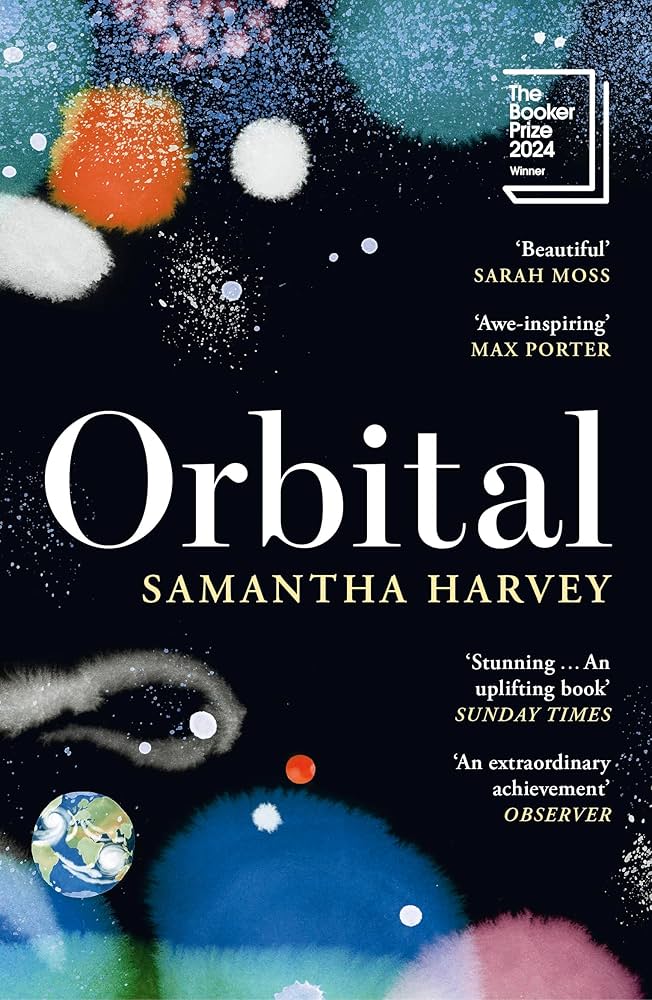
‘Orbital’ by Samantha Harvey explores the thoughts and feelings of six different astronauts as they reflect upon their existence so far. Pietro, Roman, Nell, Chie, Shaun and Anton, all starkly different from one another come together almost like a single entity to discover and study the uncharted ferocious space. The narrative is frequently interspersed with themes of religion, escapism, geopolitics and philosophy which add to its depth. I find this novel particularly thought-provoking, interesting and poignant.
Harvey vividly communicates the various cultures, philosophies and morals that govern our lives. Shaun and Nell while looking at the magnificent space share their beliefs about the existence or absence of an almighty force or God. To highlight the arbitrary nature of the universe Nell says, “What made that but some heedless hurling force?” Then, Shaun to point out that the creation of the universe is not a coincidence responds with, “What made that but some heedful hurling beautiful force?” The parallelism and use of the same sentence structure reveals that the creation of the Universe can be interpreted in many ways and each may seem perfectly logical to the beholder of that opinion. Using a rhetoric question could also suggest that philosophical inquiries do not come with a definite answer but rather are a mystery with infinite answers. The indefiniteness of answers to philosophical inquiries leave the readers both amazed and bewildered at the same time.
Moreover, Harvey’s use of descriptive language and comparisons make the narrative even more intriguing. The author utilises imaginative and striking descriptions of the earth from space and celestial objects which paint a realistic picture in the readers’ minds. Sensory details like “blanching light” make it even more evocative. Additionally, Harvey uses comparisons to mechanical, everyday things to describe celestial bodies and objects in space. This could convey that seeking familiarity in an unknown expanse is a universal human tendency. Furthermore, the writer constantly switches back and forth between the present, past and future to convey how time almost ceases to exist in space, leaving them lost and alone with their thoughts. Like time in space, the narration has no definite structure itself. The use of flashbacks about their families, friends and life back on Earth conveys how their perspectives are changing with hindsight and the life-altering experience of being in space. Also, throughout the story a number of paradoxes are utilised. For instance, “so near yet so infinite” and “edgeless edge”. The frequent use of paradoxes show that with a minute alteration in perspective the world can seem completely different. It urges the need to have an open mind and explore all facets.
Harvey makes the narrative eye-opening by incorporating the effect of geopolitics and differences in space. The labels on the toilet in space read, “American, European and Japanese Astronauts only. Because of ongoing political disputes please use your own national toilet.” This could serve as a satire for the bizarre and ridiculous restrictions placed by countries because of geopolitical strains. In addition to this, there is a “Russian” and “non-Russian segment of the craft” and a “US Treadmill”. These convey how the nations have even divided a small spaceship, highlighting how these divisions exist at even the most unexpected places and are becoming a serious problem.
In addition to this, the allusion to Las Meninas and Michael Collins give the novel an artistic dimension. ‘Las Meninas’ translates to Ladies in Waiting. In this painting, the artist paints himself painting a picture of a ruler who is looking at the ladies-in-waiting who in turn are looking at someone, who is looking at something else. The question that was posed is, “Who is the subject of the painting?”. It is in fact, the dog who has his eyes closed. Perhaps, it could be a visual representation of how human beings constantly look at other people with the aim of comparing, critiquing or seeking validation. In contrast to the human beings, the dog looks at no one, conveying how he is free from vanity, that governs our existence. Moreover, Harvey also presents the dilemma faced upon by Michael Collins. The dilemma was whether to be in the picture along with astronauts like Neil Armstrong while they are in their spaceship or to be the photographer instead. Most people would choose to be in the picture because they want to be remembered. However, it is enchanting to know that Michael Collins was the only person in the world to be standing on the dark side of the moon and not being in picture capturing the astronauts, their spaceship and the earth. In fact, the warmth of the photographer’s fingers were the only evidence of humanity because from space the people inhabiting are invisible. After knowing this most people would choose to be the photographer. This highlights how a small piece of information can make the choice seem more “enchanting” and clear.
In conclusion, Harvey in her novel emphasises the value of perspective and the immense power it holds. The indefinite philosophies, unity in the face of challenges and the many paradoxes make this novel particularly more intriguing.
Harvey vividly communicates the various cultures, philosophies and morals that govern our lives. Shaun and Nell while looking at the magnificent space share their beliefs about the existence or absence of an almighty force or God. To highlight the arbitrary nature of the universe Nell says, “What made that but some heedless hurling force?” Then, Shaun to point out that the creation of the universe is not a coincidence responds with, “What made that but some heedful hurling beautiful force?” The parallelism and use of the same sentence structure reveals that the creation of the Universe can be interpreted in many ways and each may seem perfectly logical to the beholder of that opinion. Using a rhetoric question could also suggest that philosophical inquiries do not come with a definite answer but rather are a mystery with infinite answers. The indefiniteness of answers to philosophical inquiries leave the readers both amazed and bewildered at the same time.
Moreover, Harvey’s use of descriptive language and comparisons make the narrative even more intriguing. The author utilises imaginative and striking descriptions of the earth from space and celestial objects which paint a realistic picture in the readers’ minds. Sensory details like “blanching light” make it even more evocative. Additionally, Harvey uses comparisons to mechanical, everyday things to describe celestial bodies and objects in space. This could convey that seeking familiarity in an unknown expanse is a universal human tendency. Furthermore, the writer constantly switches back and forth between the present, past and future to convey how time almost ceases to exist in space, leaving them lost and alone with their thoughts. Like time in space, the narration has no definite structure itself. The use of flashbacks about their families, friends and life back on Earth conveys how their perspectives are changing with hindsight and the life-altering experience of being in space. Also, throughout the story a number of paradoxes are utilised. For instance, “so near yet so infinite” and “edgeless edge”. The frequent use of paradoxes show that with a minute alteration in perspective the world can seem completely different. It urges the need to have an open mind and explore all facets.
Harvey makes the narrative eye-opening by incorporating the effect of geopolitics and differences in space. The labels on the toilet in space read, “American, European and Japanese Astronauts only. Because of ongoing political disputes please use your own national toilet.” This could serve as a satire for the bizarre and ridiculous restrictions placed by countries because of geopolitical strains. In addition to this, there is a “Russian” and “non-Russian segment of the craft” and a “US Treadmill”. These convey how the nations have even divided a small spaceship, highlighting how these divisions exist at even the most unexpected places and are becoming a serious problem.
In addition to this, the allusion to Las Meninas and Michael Collins give the novel an artistic dimension. ‘Las Meninas’ translates to Ladies in Waiting. In this painting, the artist paints himself painting a picture of a ruler who is looking at the ladies-in-waiting who in turn are looking at someone, who is looking at something else. The question that was posed is, “Who is the subject of the painting?”. It is in fact, the dog who has his eyes closed. Perhaps, it could be a visual representation of how human beings constantly look at other people with the aim of comparing, critiquing or seeking validation. In contrast to the human beings, the dog looks at no one, conveying how he is free from vanity, that governs our existence. Moreover, Harvey also presents the dilemma faced upon by Michael Collins. The dilemma was whether to be in the picture along with astronauts like Neil Armstrong while they are in their spaceship or to be the photographer instead. Most people would choose to be in the picture because they want to be remembered. However, it is enchanting to know that Michael Collins was the only person in the world to be standing on the dark side of the moon and not being in picture capturing the astronauts, their spaceship and the earth. In fact, the warmth of the photographer’s fingers were the only evidence of humanity because from space the people inhabiting are invisible. After knowing this most people would choose to be the photographer. This highlights how a small piece of information can make the choice seem more “enchanting” and clear.
In conclusion, Harvey in her novel emphasises the value of perspective and the immense power it holds. The indefinite philosophies, unity in the face of challenges and the many paradoxes make this novel particularly more intriguing.